
Pakistan announced a 48-hour ceasefire with Afghanistan following deadly border clashes. The agreement aims to facilitate dialogue and find a resolution to the conflict.
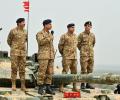
'Can a nuclear-armed nation sustain itself indefinitely under overt military rule without catastrophic consequences for itself and the region? History suggests otherwise.'
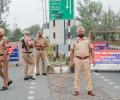
Punjab Police have apprehended six individuals, including a juvenile, involved in a cross-border arms smuggling operation. The investigation revealed connections to a foreign-based handler in Portugal, facilitating the smuggling of illegal arms from Pakistan via drones.
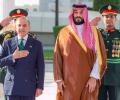
Prime Minister Shehbaz Sharif met with Saudi Crown Prince Mohammed bin Salman to express Pakistan's support for the Kingdom amidst escalating tensions in West Asia, reaffirming their mutual defence pact and commitment to regional stability.

Unidentified miscreants smashed a window and threw "petrol or similar substance" inside before igniting the blaze

Punjab Police have dismantled an ISI-sponsored terror module, arresting two individuals and recovering a cache of arms, including an AK-47 rifle and Glock pistols.

Delhi Police have heightened security across the city ahead of Hanuman Jayanti following the arrest of a suspected Lashkar-e-Taiba handler allegedly planning terror strikes. Enhanced surveillance and restrictions are in place to ensure peace during the festival.

Pakistan launched a retaliatory operation, 'Ghazab lil Haq,' against the Afghan Taliban following alleged border attacks, resulting in reported casualties and destruction of Taliban infrastructure.

India has refuted Pakistan's allegation that it denied permission to use Indian airspace for sending humanitarian aid to cyclone-hit Sri Lanka, calling the claim 'ridiculous'.

Two British nationals have been sentenced to six months' imprisonment by an Indian court for illegally entering India from Nepal. The individuals, Hassan Amman Saleem and Sumitra Shakeel Olivia, were arrested in November last year for entering without valid documents.
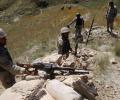
Pakistan and Afghanistan have agreed to an immediate ceasefire and setting up of 'mechanisms' to ensure lasting peace after days of violent clashes along the border that left several soldiers, civilians, and terrorists dead on both sides, officials said on Sunday.
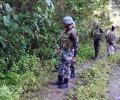
Delhi Police dismantled a major international arms trafficking module with links to Pakistan, Nepal, and Bangladesh, arresting 10 operatives and recovering a cache of foreign-made weapons.

The clock on the ceasefire is running out. But everyone's already whispering about round two, possibly as soon as this weekend.

The LPG squeeze on India's restaurant sector is the quotidian face of a deeper crisis.

Israel will continue its offensive in South Lebanon aimed at neutralising the threat from Hezbollah, which is backed by Iran.
Pakistan has handed over evidence-based demands to mediators in Istanbul talks with the Afghan Taliban, aiming to end cross-border terrorism. The talks follow recent border clashes and aim to defuse tensions between the two sides.

The delegations from the US and Iran head to Islamabad on Friday, carrying a ceasefire that is already fraying, a Strait that is technically open and practically closed, and a negotiating agenda that would challenge even parties actually negotiating in good faith, which these groups are not. Prem Panicker continues his must read blog on the Iran War.

The ceasefire is still technically holding, to the extent that no overt hostilities have been reported yet, but the rhetoric has hardened dangerously. The week ahead will also clarify whether the Islamabad failure was a negotiating tactic or whether Washington has genuinely locked itself into a position from which the only exits are climb-down, escalation, or the slow bleed of a new status quo that nobody chose and nobody controls. Prem Panicker continues his must read blog on the Iran War.

Trump has made it clear: the US will not lift its blockade of Iranian ports until a deal is signed.

Pakistan boycotted the Bonn Conference to emphasise to the world community the importance of its sovereignty even though it wants peace and stability in Afghanistan, Foreign Office spokesman Abdul Basit said on Monday.

Pakistan and the Afghan Taliban have resumed peace talks in Istanbul, aiming to address cross-border terrorism and prevent further escalation. The talks follow recent clashes and a temporary ceasefire, with Pakistan demanding that Afghan soil not be used for terrorism.

'We expect inbound numbers in 2025 to come close to pre-pandemic levels -- if not fully match them -- by early 2026.'

Iran's Foreign Minister Seyed Abbas Araghchi on Sunday issued a formal address and said that the event is a moment of profound religious and historical consequence.

'The next two to three weeks will not be decided in Washington.' 'They will be decided in Tehran, in whatever calculation Iran makes about the costs of continued resistance against the costs of appearing to have yielded.'

Western Army Commander Lieutenant General Manoj Kumar Katiyar reports a sustained decline in militancy in Jammu and Kashmir, emphasizing the army's readiness to respond to any misadventures by Pakistan and its support for terrorist activities.

This weekend, Donald Trump has begun to say the quiet part out loud -- that he wants to take control of Iran's oil, a formulation more in line with his robber-baron style of international relations.

The Bharatiya Janata Party on Tuesday said it held a formal meeting with a Chinese delegation openly, given the "improved" relations between New Delhi and Beijing, unlike the Congress which, it alleged, "secretly" signed a memorandum of understanding with the neighbouring country's ruling party.

Relations with India experienced a downturn during Yunus's tenure, while ties with Pakistan saw positive developments.

Pakistan has voiced concerns over the alleged variations in the flow of the Chenab River and has written a letter to India seeking clarification. They also commented on an incident in Bihar involving the removal of a Muslim woman's veil.

Pakistan launched fresh air strikes targeting terrorist hideouts in Afghanistan, killing several people, including three cricketers, casting a shadow over the expected talks in Doha amid a fragile ceasefire that had temporarily halted hostilities between the two sides.

In a major counter-terror operation spanning three states, the Delhi Police has dismantled a Lashkar-e-Taiba (LeT) module comprising eight operatives, including seven Bangladeshi nationals who had illegally entered India and procured forged identity documents, an official said on Sunday.

The attack came less than three months after a suicide bomber killed 12 people in a blast outside a district and sessions court building in Islamabad.
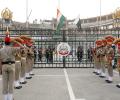
Pakistan's Foreign Office spokesperson Shafqat Ali Khan said on Friday that the ceasefire with India was holding and the country is committed to it. He also said that Pakistan is committed to making the ceasefire hold and de-escalation succeed, and then engagement to lead to stability and resolution of issues. Khan said that the two militaries have a channel of communication through the Directors General of Military Operations, through which they are working for de-escalation, in terms of the movement of troops. He added that Pakistan remains committed to the ceasefire announced on May 10 and lately, both sides have taken steps for de-escalation and return of stability.

Tarique Rahman is Bangladesh's first male prime minister in more than three decades, ending an era of female leadership that began in 1991.

Lok Sabha Speaker Om Birla and Foreign Secretary Vikram Misri attended the swearing-in ceremony.

Pakistan summoned the Afghan ambassador to convey its strong reservations over the India-Afghanistan joint statement issued in New Delhi, particularly regarding references to Jammu and Kashmir.

Punjab Police announced the busting of two terror modules ahead of Republic Day, resulting in the arrest of six operatives and the seizure of arms and ammunition.
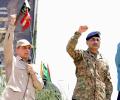
'If the Trump administration could gain access to the nuclear weapons, they would be satisfied -- at least they could control them.'

Assam Chief Minister Himanta Biswa Sarma has accused Congress MP Gaurav Gogoi of having a 'deeper connection' with a Pakistani national and violating FCRA rules, prompting calls for a national probe.

Today's situation in the Shaksgam Valley is the consequence of what happened in Gilgit in 1947. But is India ready to militarily get back its territories? asks Claude Arpi.
 © 2026 Rediff.com - Advertise with us - Disclaimer - Privacy Policy - Sitemap - Feedback - About us - Terms of use - Grievances